Pintxos in Basque Country
In San Sebastián's old town, the pintxo bar is a civic institution: a few square meters of marble counter, a crowd standing two-deep, and a small, deliberate piece of food built to be eaten in three bites.
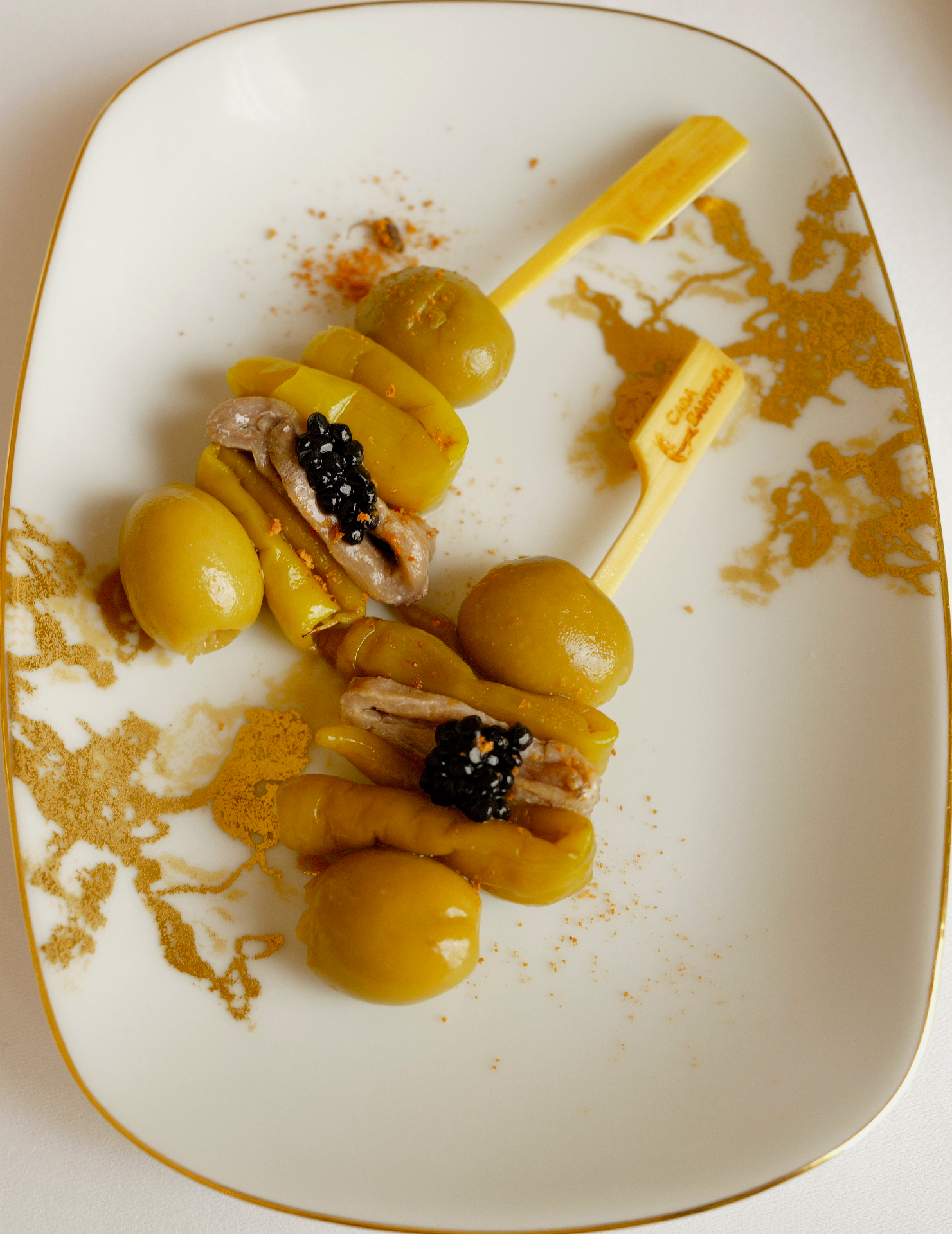
San Sebastián - Donostia, in Basque - sits on a curved bay on Spain's northern coast, and its old town, the Parte Vieja, contains one of the densest concentrations of bars in Europe. Most of them serve pintxos: small, composed bites traditionally pinned together with a wooden skewer, from which the name derives (pintxar, to pierce).
The pintxo is often described as the Basque cousin of the tapa, but the comparison undersells it. A tapa is usually a small portion of something larger - a saucer of olives, a few slices of jamón. A pintxo is composed: built as a single object, intended to be eaten in two or three bites, and designed so that every element registers at once.
The classic example is the Gilda, named in the 1940s after Rita Hayworth's film of the same name. It is three ingredients on a skewer - a salt-cured anchovy, a pickled green guindilla pepper, and a manzanilla olive - and nothing else. The balance is the point: salt, acid, heat, fat, all calibrated against one another. Bars across the city still serve it essentially unchanged.
The standard ritual is simple. Customers stand at the bar rather than sit. Pintxos are often arrayed along the counter on small slices of bread; hot ones are ordered from a chalkboard and brought out from the kitchen. A glass of txakoli - the slightly effervescent, high-acid wine of the region, usually white though rosé and red versions are also made - is poured from a height to aerate it. The bill is settled at the end, often on the honor system at neighborhood bars, though more tourist-oriented establishments tend to tally orders behind the counter.
The city has, since the 1970s, also been a center of Spain's high-end cuisine. The surrounding province of Gipuzkoa holds an unusually high concentration of Michelin stars per capita, and chefs from restaurants like Arzak, Mugaritz, and Martín Berasategui's flagship in Lasarte-Oria have, over decades, exported Basque techniques worldwide. But the pintxo bar remains the everyday form of Basque eating - informal, social, and built around the idea that good food is something you stand up for, briefly, before moving on to the next bar.
That movement between bars - the txikiteo or poteo - is itself part of the tradition. One drink, one or two pintxos, then on to the next place. It is a way of eating that resists the table, the reservation, the long sit. It assumes that conversation belongs in the street as much as at dinner, and that an evening is best assembled, like the pintxo itself, from small, deliberate pieces.
— The Editors
Connected in soul to twfim. Discoveries told through the table.